The Seven Churches
of Asia
Being a Full Account of the Seven Letters Sent by Our Lord
to the Seven Congregations of the Province of Asia Minor
Revelation II:I — III:XXII · c. AD XCVI · The Island of Patmos
The Beloved Disciple
Saint John the Apostle & Evangelist
Fisherman, apostle, exile, and elder — the last of the Twelve, and the one to whom the Revelation was given.
c. 6 A.D.
Born at Bethsaida, Galilee
c. 27 A.D.
Called by the Sea of Galilee
c. 30 A.D.
Entrusted with Mary at the cross
c. 95 A.D.
Exiled to Patmos under Domitian
c. 100 A.D.
Died peacefully at Ephesus
I. Birth & Family
A Fisherman of Galilee
John was born, by long tradition, around the turn of the first century, in or near the fishing town of Bethsaida on the northern shore of the Sea of Galilee. Scripture identifies his father as Zebedee, a fisherman prosperous enough to employ hired hands alongside his own sons (Mark 1:20) — a detail suggesting the family was not poor, but a working household of some standing.
Comparing the lists of women present at the crucifixion in the Gospels (Matthew 27:56, Mark 15:40, John 19:25) has long led readers to identify John's mother as Salome, and to suggest — cautiously, since the text nowhere states it outright — that she may have been a sister of Mary, the mother of Jesus. If so, John and his elder brother James would have been Jesus's first cousins, which would help explain both their early access to him and the boldness of their mother's later request for places of honor at his side (Matthew 20:20-21).
John's elder brother was James, later called James the Greater, who would become an apostle alongside him and, in time, the first of the Twelve to be martyred. The brothers worked the family boats and nets on the Sea of Galilee, in partnership with another pair of fishermen brothers, Simon Peter and Andrew. Jesus gave James and John the nickname Boanerges, "Sons of Thunder" (Mark 3:17) — a name that has puzzled readers ever since, but which the Gospels illustrate well enough: it was John and James who once asked Jesus's permission to call down fire on a Samaritan village that had refused him hospitality (Luke 9:54).
II. Relation to Jesus
Apostle and Beloved Disciple
John and James were called away from their nets by the Sea of Galilee, leaving their father Zebedee in the boat with the hired men (Matthew 4:21-22), and became two of the Twelve Apostles. Of the Twelve, John belonged to the innermost circle of three — with Peter and his own brother James — whom Jesus drew apart at the most significant moments of his ministry: at the raising of Jairus's daughter (Mark 5:37), at the Transfiguration on the mountain (Matthew 17:1-2), and in the garden of Gethsemane on the night of his arrest (Mark 14:33).
Church tradition, reading the Fourth Gospel's own internal clues, has long identified John as "the disciple whom Jesus loved" — the disciple who reclined next to Jesus at the Last Supper (John 13:23), the only one of the Twelve recorded as standing at the foot of the cross, and the one to whom Jesus, dying, entrusted the care of his mother: "Woman, behold thy son! ... Behold thy mother!" (John 19:26-27). From that hour, the Gospel records, "that disciple took her unto his own home."
John was also the disciple who outran Peter to the empty tomb on the morning of the resurrection (John 20:2-8), and one of those present at the Sea of Galilee when the risen Christ appeared a third time to his disciples (John 21). In the years that followed, he appears repeatedly alongside Peter in the earliest chapters of Acts — at the healing of the lame man in the Temple, before the Sanhedrin, and sent together to confirm the new believers in Samaria — and Paul later names him, with Peter and James the Lord's brother, among the acknowledged "pillars" of the Jerusalem church (Galatians 2:9).
III. Ephesus
Elder of the Church in Asia
How and when John left Jerusalem for Ephesus is not recorded in Scripture, but the tradition placing him there is old and widely attested — running through writers such as Irenaeus and Polycrates of Ephesus in the second century, and Eusebius of Caesarea in his fourth-century church history. By this account, John became the leading elder of the churches of the Roman province of Asia, the same seven congregations later addressed in the Book of Revelation.
A closely related tradition, especially cherished in later Catholic and Orthodox devotion, holds that John brought Mary, the mother of Jesus, to Ephesus with him — fulfilling the charge given him at the cross — and cared for her there for the remainder of her life. A small stone house on a hillside outside Ephesus, known today as the House of the Virgin Mary, is venerated by many as the place of her final years, though the tradition connecting it to this site is considerably later than the apostolic age itself.
From Ephesus, John is traditionally credited with the writing of the Gospel that bears his name and the three epistles attributed to him, and with the pastoral oversight of the churches of Asia. Irenaeus — who as a young man had heard the preaching of Polycarp, the bishop of Smyrna — records that Polycarp himself had been a disciple of John, making John a living link between the generation of the apostles and the church of the early second century. Later, non-canonical writings such as the apocryphal Acts of John preserve a rich body of legend from Ephesus as well, including a famous confrontation at the great pagan Temple of Artemis that dominated the city — stories cherished by later generations, even where their historical reliability cannot be verified.
IV. Patmos
Exile and Revelation
Under the emperor Domitian, who ruled Rome from 81 to 96 A.D. and whose later years saw a marked hostility toward the church, John was banished to Patmos, a small, rocky island in the Aegean Sea — by his own account, exiled "for the word of God, and for the testimony of Jesus Christ" (Revelation 1:9).
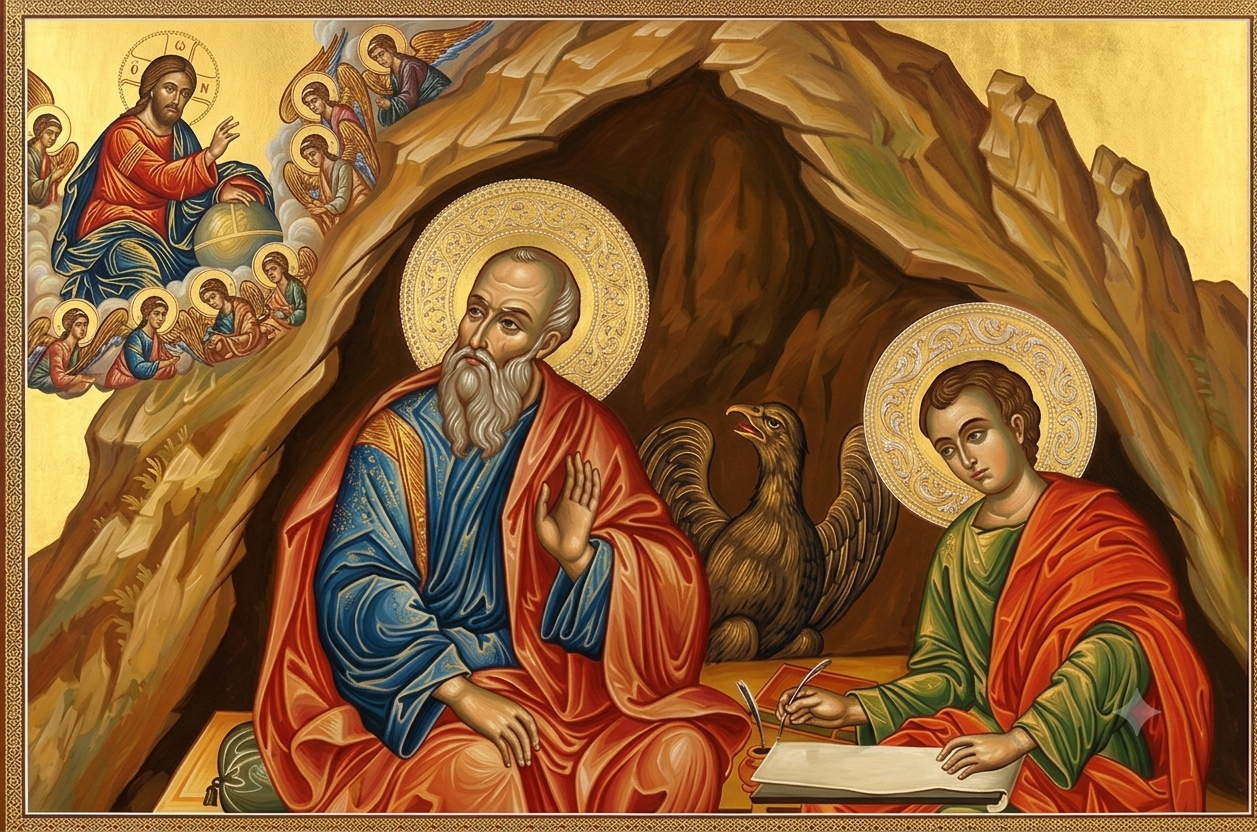
It was on Patmos, "in the Spirit on the Lord's day," that John received the series of visions recorded in the Book of Revelation, addressed first of all to the seven churches of Asia whose letters this site sets out in full. Tradition, attested from at least the early Byzantine period, locates the site of this vision in a cave on the island, still shown today as the Cave of the Apocalypse and now enclosed within a monastery.
Domitian was assassinated in 96 A.D., and his successor, Nerva, reversed a number of his policies, including, by tradition, the sentences of exile passed under his predecessor. John is said to have been released and to have returned to Ephesus, where he spent his final years.
V. Death
The Last of the Twelve
Church tradition holds, with unusual consistency, that John was the only one of the Twelve Apostles to die of natural causes in old age rather than by martyrdom — though tradition just as consistently insists he did not escape suffering for the faith. Tertullian, writing around the year 200, records an early account that John was plunged into a vat of boiling oil in Rome, before the city's Latin Gate, during Domitian's persecution, and emerged from it unharmed before his exile to Patmos — an episode still commemorated in Western liturgical calendars each May 6th.
By most accounts, John lived to a very great age in Ephesus, outliving every other apostle, and died peacefully there around the year 100 A.D., during the reign of the emperor Trajan. Later legendary material, preserved in the apocryphal Acts of John, describes his final hours as remarkably serene, even instructing his own followers to prepare his grave before he lay down in peace. Such accounts, together with a saying of Jesus about him recorded in the Gospel itself — "If I will that he tarry till I come, what is that to thee?" (John 21:22) — gave rise to a folk belief in some quarters that John had not truly died at all, but slept until Christ's return. The Gospel of John corrects this very misunderstanding in the next verse, noting plainly that Jesus never said John would not die, and the belief was firmly set aside by mainstream Christian teachers such as Augustine not long after.
In the sixth century, the Byzantine emperor Justinian I built a great basilica over John's traditional tomb on Ayasuluk Hill, overlooking Ephesus. Its ruins can still be visited today, within sight of the ancient city where, by tradition, the last of the Twelve Apostles lived out his final years, and not far from the ruins of the very church to which the first of the seven letters in this collection was addressed.
“That which we have seen and heard declare we unto you, that ye also may have fellowship with us.”
1 John I:III